



Laureen Lynch-Ryan serves as the Coordinator of Deaf Ministry at the Office of Deaf and Disability Ministries for the Roman Catholic Archdiocese of Washington, a position she has held since 2009. She is an accomplished Deaf social worker with nearly 35 years of experience serving Deaf and hard of hearing individuals across a wide range of settings. Earlier in her career, Laureen worked as an advocate counselor for Seattle Rape Relief and later founded the Deaf Abused Women’s Network in Washington, DC, demonstrating her long-standing commitment to advocacy and support within the Deaf community. Since 2021, she has also served as an instructor for an online course in the Deaf Ministry Formation Program.
Currently, Laureen serves on the Board of Directors for two nonprofit organizations: the Deaf Catholic Youth Initiative for the Americas and the Deaf Ministry Formation Program.

Is a highly accomplished Deaf professional and educator with over 25 years of experience specializing in curriculum design, literacy, and mental health. A versatile leader, she has held diverse roles ranging from K-12 administrator and literacy coordinator to university instructor. Her academic contributions include designing Bachelor’s and Master’s degree programs and teaching courses in ASL Linguistics, Deaf Studies, Interpreter Training, and the intersection of Mental Health and the Deaf community. Beyond the classroom, Maryann is a recognized expert in specialized assessments for Deaf, Deaf-Disabled, and Deaf-Blind individuals. Her clinical background as a National Certified Counselor (NCC) and Reality Therapy Certified (RTC) practitioner informs her holistic approach to education and advocacy. Since 2001, she has been a cornerstone of the Deaf Catholic Youth Initiative for the Americas, serving as a Board Member and a dedicated leader for the “Encuentros” youth meetings. An internationally sought-after speaker, Maryann has presented workshops across various modalities in both high school and university settings. Her career is defined by a deep commitment to linguistic accessibility, program innovation, and empowering the next generation of the Deaf community on a global scale.

With more than a decade in forensic psychology, my primary mission at MPF MZA is to lead criminal reconstruction. My experience in psychopathology and critical thinking drives our team to unravel the complexities of cybercrime and sexual abuse cases. Our commitment aligns with MPF MZA’s dedication to justice, ensuring that we offer diverse perspectives when addressing digital violence. My current role involves heading investigations on grooming and cybercrimes at Boston University, utilizing my knowledge in intelligence analysis and outcome evaluation. This experience, added to my teaching in legal medicine at the National University of Cuyo, allows me to contribute to the development of innovative strategies to combat and understand digital criminal behavior.

Dr. Irma Patricia Espinosa Hernández is a surgeon, psychiatrist, psychotherapist, and specialist in criminology and theology. She has a distinguished academic background that includes master’s degrees in Humanities and Dogmatic Theology from the Pontifical University Regina Apostolorum in Rome, as well as a doctorate in Forensic Psychopathology. She is a certified International Criminal Profiler and a specialist in negotiation, personality, and non-verbal language.
At the institutional level, she is a member of the Pontifical Commission for the Protection of Minors and Vulnerable Persons at the Vatican and the National Council for the Protection of Minors of the Mexican Catholic Bishops’ Conference (CEM). She is a founding member of the Latin American Council of CEPROME Latin America, where she serves as Academic Director. Furthermore, she has extensive teaching experience across universities in Latin America, Spain, and Rome, and serves as a consultant for episcopal conferences, dioceses, and religious congregations on child protection and the safeguarding of vulnerable individuals.
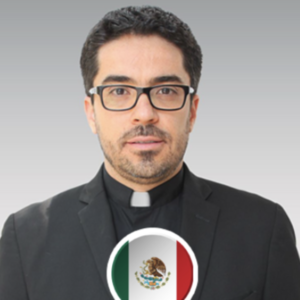
Priest of the Archdiocese of Chihuahua. He studied a licentiate in Spiritual Theology and a specialization in Priestly Formation at the Pontifical Gregorian University in Rome. Later, he obtained a master’s and doctoral degree in Psychoanalysis from the Intercontinental University and a doctorate in Theology from the Pontifical University of Mexico (UPM). Currently, he is the director of the Interdisciplinary Center for Research and Formation for the Protection of Minors and director of the Latin American Council of CEPROME. He is a full-time professor at the Pontifical Gregorian University and a member of the international commission for the protection of minors of the Order of Augustinian Recollects. His lines of research are priestly formation, the prevention of sexual abuse of minors within the Church, and the integration of spiritual theology and psychology. Among his publications is the book: Psico-Teología del Discernimiento vocacional (Psycho-Theology of Vocational Discernment), an attempt to protect against sexual abuse of minors in the Catholic Church. He has coordinated several works on the topic of prevention, such as: Zero Tolerance, Prevention in the Church in the Digital Era, The Protective Environment of Catechesis, and others.

Dr. Consuelo Manero Soto, “Chelo,” has a career spanning more than 30 years that merges high-specialty clinical psychology with pioneering leadership in inclusion. A graduate in Psychology from Anáhuac University, with a Master’s in Mental Health and Psychotherapy from Gallaudet University and a Doctorate in Permanent Education, she holds international certifications in positive psychology, crisis intervention, and psychological first aid. Her career is highlighted by innovation and project creation, having dedicated 22 years to Marista University as Director of the School of Psychology and the Inclusion Center, as well as being a key piece in implementing resilience programs at “Hearing Loss Link” in the United States. Since 1999, she has maintained a private clinical practice, providing individual and couples’ consultancy and psychotherapy, a labor she has complemented for years at ABC Hospital and the CdelaF Clinic. She has participated in accompanying survivors of sexual abuse for several years as a therapist and as an SL interpreter. She has also been an American Sign Language interpreter since 1992 and, since 2020, collaborates with Vatican News Media. Her social vocation is also reflected in the founding of Deaf Catholic Youth Initiatives of the Americas (DCYIA) and her work on the Board of Directors of Casa de la Sal.

Archbishop John Joseph Kennedy (born July 15, 1968) is a high-ranking Irish prelate who serves as the “point man” for the Vatican’s response to clerical misconduct. Born in Clontarf, Dublin, he was ordained for the Archdiocese of Dublin in 1993 before moving to Rome to specialize in Canon Law at the Pontifical Gregorian University, where he earned his doctorate. As the Secretary for the Disciplinary Section of the Dicastery for the Doctrine of the Faith (DDF), Kennedy holds one of the most sensitive roles in the Catholic Church. He leads a specialized team of officials tasked with processing and judging credible allegations of sexual abuse against the clergy. Kennedy has been a vocal advocate for transparency, describing the fight against abuse as a “tsunami” of cases that the Church must meet with forensic justice. In 2023, Pope Francis specifically instructed the DDF to separate its doctrinal work from its disciplinary work, effectively placing Kennedy in primary charge of abuse cases. In addition to his Vatican duties, Kennedy is a member of the board of the DCYIA. In September 2024, he was elevated to the rank of Titular Archbishop of Absorus.

Father Joe Mulcrone is a fundamental figure in pastoral care for Deaf people worldwide. Born in Chicago, he grew up in a service-oriented family: the son of a police officer and an interpreter, and the grandson of Deaf grandparents. This personal connection led him to master American Sign Language (ASL) and dedicate his life to inclusion within the Church. As Director of the Catholic Office of the Deaf in Chicago for over 40 years, his impact has transcended borders. He was key in organizing the historic “EFPHATHA” conference at the Vatican (2009) and in creating the DCYIA. However, his most courageous work has been the fight against sexual abuse. Upon detecting an alarming vulnerability in Deaf youth, Father Joe became a pioneer in the prevention and healing of survivors with disabilities. He has promoted specialized services to break the silence on abuse in this community, ensuring victims have a voice and justice.

Dr. Ian Robertson is a renowned theologian, educator, and human rights advocate based in South Florida. He holds a Doctorate in Theology and Ministry and has been a key figure in professionalizing Deaf leadership through his work at St. Thomas University (STU) in Miami. There, he was fundamental in creating master’s programs specifically designed for Deaf people. As Director of the Ministry Formation Program (MFP), Robertson leads national theological formation in American Sign Language (ASL). In his role as Vice President of the DCYIA, they have led child protection projects in the Americas. His work focuses on combating sexual abuse through education and mental health, exposing how linguistic isolation increases abuse and discrimination.
Daiana Gisel Lizarraga is a dedicated advocate for the Deaf community and a community leader based in Mendoza, Argentina. As an alumna of the Antonio Próvolo Institute, her courage and commitment have led her to take an active role in seeking justice, dignity, and protection for Deaf individuals.
Currently, she serves on the Culture Committee of the Deaf Association of Mendoza (Asociación de Sordos de Mendoza) and is furthering her training in Argentine Sign Language (LSA) instruction through the LSA Instructors Group (GILSA), focusing her efforts on promoting Deaf culture, community representation, and inclusion.

Lic. Nancy G. Cortez is an Advanced Argentine Sign Language (LSA) Interpreter with extensive experience in legal, legislative, educational, and broadcast media environments. She is officially registered as a certified legal interpreter with both the Judicial Power of Mendoza and the National Judicial Power of Argentina.
Her career highlights include serving as an official LSA interpreter for the Legislature of Mendoza, providing educational interpretation in higher and adult education institutions (such as IES 9-017 and CENS 3-425), and working as a broadcast sign language interpreter for the midday news program on TV Canal 7 Mendoza (LV89).

Deborah Pizzarro is an experienced Deaf education specialist and certified Argentine Sign Language (LSA) interpreter with over three decades of professional dedication to accessibility, education, and language rights. She holds degrees in Deaf Education and Speech Therapy, as well as an Advanced Degree in Sign Language Interpretation from the National University of Cuyo.
Throughout her distinguished career, she has worked extensively in educational, academic, and municipal settings. She served as a university lecturer in sign language systems and interpretation techniques at the National University of Cuyo, and has provided continuous, high-level interpreting services for the Municipality of the City of Mendoza since 2007.
Her work encompasses judicial, civic, and cultural domains, notably serving as an official LSA–Spanish interpreter in high-profile legal cases such as the Próvolo proceedings (2016–2020), as well as interpreting for major national conventions, cultural events, and research projects. She is also an independent researcher and author in the field of accessibility and Deaf culture.

Dr. Oscar Gerardo Barrera is an Argentine attorney with over 35 years of experience in private practice across various legal fields, consistently focusing on the defense and promotion of human rights. He possesses extensive experience in public interest law, legislative advising, and participation in high-impact social cases, such as representing as plaintiffs the Deaf and hard-of-hearing survivors of ecclesiastical child sexual abuse at the Instituto Antonio Próvolo in the Province of Mendoza, Argentina, as well as in civil proceedings for damages suffered by said victims.
He served as Director of Legal Affairs for the former Ministry of Human Development, Family, and Community of the Province of Mendoza, and currently, since 2013, as ad honorem legal advisor to the Office of the Ombudsman for Persons with Disabilities of the Province of Mendoza. He is also an advisor to NGOs for Deaf individuals and a regular member of the Ethics and Discipline Tribunal of the Bar Association of Mendoza.